More Leg!

I try to stay quiet most of the time when controversial issues come up, because quite honestly I like staying out of it and just enjoying my quiet little farm with my amazing clients and horses. However, lately, I can’t ignore it because it’s coming up far more often and people who I’ve never heard of are making statements that absolutely blow my mind sometimes. The most recent example was a long post going on and on about how trainers who say “more leg” are not good trainers and essentially are inadequate. The other premise of the article was correct. You cannot simply add “more leg” all the time and fix the issue of a horse not being forward or moving off your leg. It does take more than simply squeezing harder or giving a little kick, but the idea that hearing an instructor say “more leg” means they’re not effective at coaching is blasphemy. Chances are, you hear “more leg” in every warmup ring across the US and the world. You should expect to hear it there. That’s what a short phrase is meant for! You see, at home we don’t say “more leg” as often. Sometimes we don’t say it at all. Sometimes we say it often because we’re working on course or grid work and we have to, but have you ever asked yourself why?

Let me explain…. My instruction at home is much more in depth. We break things down and I explain it in excruciating detail in most cases. I explain how we use our leg, our hands, our crop, and maybe a spur if it is needed. I go over just how hard to squeeze, how to squeeze or push, how to supplement with the crop, when to supplement with the crop, and when to get louder with the aids if you’re not getting the response you want. I teach my students how to ride but more importantly how to FEEL. They have to understand the feeling they’re looking for and how to achieve it. They need to understand how each part of their body works together to achieve their goal. They also have to understand how to get a response from a horse, ride a “spicy” or “spunkier” horse, and how to correct a “disobedience” when it happens. (They should also know how to feel/tell the difference between a disobedience and a pain response, or know when they’re not sure and assume pain, but that is a totally different discussion!)

Now, let’s take that massive amount of word vomit and apply it at a show. Do you think that I should be taking them to a show if I need to explain what they should do in more words than just “leg!” Or “more leg!”? NO. Absolutely not. I teach them in detail at home so when we go to a show and they hear me shout “more leg!” Or “use your crop!” They know exactly what to do, how to handle it, and achieve what we want. Otherwise, I am sending a rider into a show ring where I CAN’T coach, and hoping/praying they remember their course and come out alive. It would be irresponsible of me to not make it so all I need to say in the warmup is something as simple as “more leg” or “get him more forward”. And quite honestly, you will only hear a handful of short phrases from me in that warmup ring because I am trying to be both respectful of other coaches and riders AND direct and to the point so I can get my commands out quickly! If I can see that my short phrases (which they have been trained on and understand ahead of time) are not working, then I will pull them to the edge of the ring, out of the way where I can quietly coach them or chat with them in more detail. I leave you with this little nugget of wisdom – when my student is two strides before a jump and needs more energy, I can’t fit 15 words in, so I fit two – “add leg!”

The Importance of a Connected Seat and Independent Hands

Hold on tight, because this one may rock the boat a little. I’ve had a relatively successful lesson program for about a year now and I’ve noticed some rather concerning trends along the way that make me a bit worried for the success of young riders in my area. (Oh, there it is, I’ve triggered you haven’t I?) Now, clearly I don’t have a boatload of teaching experience, however I’ve had the pleasure of learning from many trainers, and observing how many different people teach over the years. It’s that experience that rolls into the mountain of teaching expertise that I feel that I have. Note the difference there – It’s a knowledge level and “expertise” in riding, NOT teaching experience. I am now gaining real hands on teaching experience that has helped me develop and expand that expertise and knowledge more. In some ways, perhaps what is lacking in some other programs is a difference of perspective. Barns become so focused on their teaching methods and their process that they fail to take the time to observe others and take lessons themselves to see new advancements and methods of teaching that might far surpass what is now considered “old school”. I don’t think that is the only issue, but let’s move on. The purpose of this article is the importance of a connected seat and independent hands anyway, isn’t it? We’ll touch on teaching issues more a bit later.

A connected seat is perhaps your most valuable tool in your tool box when it comes to riding horses. If you cannot feel a connection with the horse through your seat then you are missing out on what riding is really about, in my opinion anyway. Your seat should be your primary method of communication with your horse. You can use your seat to drive the horse forward, to maintain the rhythm in the gaits, to slow the horse or stop the horse, to steer the horse, and so on. The seat seems to be a bit underrated by some other programs. I teach a bit backwards I think compared to most in my area. I make my students develop a connected and fluid seat before they learn two point/jumping position or learn to post the trot. Most programs would teach the post first because it’s “easier” for most people to learn and that is not wrong. However, the problem is if you teach a child to post and you don’t take the time to teach them to sit, they miss out on just how valuable their seat truly is. Once you give someone the easy way out, they’ll always take that route. Even the most advanced riders would rather post than sit because physically it is easier. BUT those advanced riders know how to use their seat and connect it when needed, even in the posting trot, and that is the difference!

What I’ve found a lot of people don’t realize, even those who have been riding for years, is that you can also use the posting to control the rhythm and speed. So many riders come to me with no control over their post and while I’m not going to say “they flop around like a fish”, they certainly don’t post with any sort of precision or control. Something I learned from a local hunter trainer was to focus on how I land from my posting, which I think was probably the most valuable lesson she ever taught me. I’d always known you could control your posting to control the rhythm and speed, but I had never even thought of how I was landing on the horse. If you can post and barely touch the saddle when you are in the “down” of the post, how much happier and more comfortable do you think your horse will be? Have you ever taken the time to pay attention to how hard you land on the horse’s back? If not, I encourage you to think of that. Your horse will thank you! And the best part is, even when you’re landing lightly, you’re still connected with the horse – just much lighter and more fluid than you were when you were flopping heavily on their back.

Now a lot of what I’m talking about now has to do with body mechanics, strength, and general rider fitness. A strong and solid base (and connected seat) make a great rider, no matter their experience level. In order to achieve such a connected seat and strong base, you have to push yourself further fitness and strength wise, even outside of the saddle sometimes. People who ride every day may not feel like they need an added workout, but those who don’t ride as often can benefit from exercises outside of the saddle to strengthen and supple the muscles used in the saddle. Once you have a strong and steady base, having independent hands is a walk in the park! I’ll be vulnerable for a minute here, and be completely honest. I have been riding for 17 years, and it took me 15 years to find my real and true connected and steady base. I would hate to admit to you the number of times that I was thrown by “dirty stoppers” at jumps. It’s downright embarrassing, BUT no one ever took the time to teach these body mechanics to me. I had to learn on my own through careful study and practice. And what did I learn? Well, I learned just how important it is to not hollow your back and to instead engage your core and roll your hips underneath you. Now – this is a little different for women than men, because we do actually have a different bone structure. TikTok, of all things, is actually what finally explained everything I needed to know. Men don’t have to tuck or roll their hips underneath them, because their pelvic structure already puts them in the right spot. Women on the other hand have to tuck their hips under so they are actually sitting on their butt/seat and have a flat/straight back. So, if you come to me for lessons, and find yourself being knocked down a few levels, that’s because I do not allow anyone to advance or continue to ride at their level until they learn how to ride in the most safe and connected way they can. I’m sure I’ll upset a few people along the way, but I urge you to trust the process and press on. In most cases, those who truly commit will be back to the level they were within a month or two. It’s just a matter of having an open mind and being wiling to embrace something new.

And without further delay, let’s discuss independent hands. I don’t think I need to go over the importance much here other than to say you need to be able to carry your hands to effectively use the reins as an aid. What I have found in students that come to me from other programs is that they rely heavily on their hands for balance. This means that their balance is too much in their upper body and they don’t have a solid base to work with. If a rider comes to me and is holding themselves up in two point with their hands I am genuinely concerned. Especially if that rider tells me they’ve already been jumping. Have other programs lost sight of the dangers of jumping ahead, being too heavy in your hands, and general safety? This is what concerns me. If someone comes to me and is jumping in their current program, I expect that they can at the very minimum, stay in two point without resting their hands on the horse’s neck for stability OR that they are not pulling on my horse’s mouth to hold themselves up. It makes me genuinely feel bad for the horses they must be riding elsewhere, because their mouths are taking a serious beating.

So here’s my hot take on when I feel the rider has “independent hands” and is capable of riding off the lunge line – the rider must be capable of sitting the gait without holding on with their hands at all before I will allow them to migrate off the lunge line. This means, they could literally be doing the disco with their hands while the horse is walking, trotting, or cantering without issue. Obviously, you’re not going to “disco” while you ride, but I like to use that as an example, because truthfully, if I hand you a glass of wine and send the horse off at a canter, you should at least be capable of sitting and holding it – regardless of whether or not there is wine in the glass when you stop. In fact, my favorite challenge is the coffee mug challenge, where I give each rider two mugs full of water and have the horse walk, trot, and canter. We see how much water is left at the end, and whoever has the most wins. (Each rider is only asked to do the level they are currently at, so we have a walk group, a trot group, and a canter group). Riders that have come to me from other barns who are currently cantering and jumping, cannot even fathom walking and trotting in this challenge, and that is a HUGE red flag! That means, they don’t have independent hands, and have a really rocky base.

Now we’ve circled back to my original point at the beginning of this article. I am genuinely concerned with the success of young riders. If we are skipping teaching them solid basics, a connected seat, and independent hands, what are we actually doing? They’ll never rise through the levels that way – regardless of whether they intend to be an amateur or a professional. Sure, I’ll bet that 50% of the people in lessons are just doing it for “fun” and don’t intend to compete but for god sake they should do it safely! It makes me sad to see riders cantering and/or jumping with such an awful and unsafe position. Regardless of the discipline, the rider should be taught the same basics. Stop this nonsense of “stick your butt out” over the jump, which is hollowing the back and severely limiting range of motion. Teach riders to engage their core! Teach them to have a connected and well developed seat! And most importantly, teach them to carry themselves! We cannot ask the horses to carry themselves if we cannot do the same for ourselves. And more importantly, we shouldn’t ask the horses to carry us if we cannot have enough body control to not harm them in the process. Regardless of the goals of the rider, a good connected seat, and independent hands are the most important things they should learn. Even if all they want to do is walk down trails.

Equestrian Wear On A Budget

Whether you’ve been in the horse world for a while or you’re just getting started, “dressing the part” can get quite pricey. Here are a few of my #lifehacks to help you get the right clothing on a budget.

Boots

Boots are the first thing that generally cost an arm and a leg (literally). I know when I was boot shopping for my next pair of tall show boots, I found myself in a bit of a sticky situation. I needed wide calf boots, but the only boots I could find at the time were almost $400. I rarely spend more than $100 on myself, let alone $400. After giving up and waiting a while I started searching again and came across Smartpak’s brand of boots, Eliza. They were on the lower end of the price scale, I believe they came in around $150-170 for tall boots and far less than that for paddock boots, which was much more my speed when it came to paying for boots. On a whim, and more as a last ditch effort to find black show boots before showing in my brown lace up boots I use at home, I ordered a pair. They’re probably the nicest boots I’ve ever owned if I’m being honest. They’re nice and comfortable, not too stiff, and had a lovely zipper up the back. And full disclosure, I am not sponsored by Smartpak, nor do I have any reason to promote this particular brand aside from the fact that it is affordable, comfortable, and stylish. The average equestrian can most certainly afford these and they are perfect for everyday wear and for horse shows. So my first lifehack, is to check the Smartpak boots out before you go spending boatloads on bigger more expensive brands. You’ll thank me later!

Breeches & Accessories

Okay, here’s where my real, true, love this brand, would wear it anywhere, life hack comes in. If you’re looking for affordable, comfy, and durable breeches, look no further than Esprit Equestrian Wear. They have so many incredible colors and styles that I absolutely love, and they are genuinely the most comfortable riding pants I’ve ever worn. I’ve tried several other brands who’s names I will not mention that were close in price, or not much more expensive than these, and these breeches so far are the best I’ve found. When I say that I could wear them as pajamas, I’m not kidding. I mentioned my struggle with finding boots that fit, and I’m sad to say that because of my athletic and thick calves even finding breeches that felt good was a struggle. I was often left with seam markings on the sides of my lower legs because of how tight the breeches that should fit me were. I ordered a pair of Esprit breeches, just to give them a try, and I immediately placed another order. Several of my students have also placed orders and love their breeches as well. They’re soft, stylish, and incredibly flattering on all body types. I even have a pair of their white and gray PRO tights to use for my shows this year. If you click the link above, you’ll actually save 5% on your first purchase with them, because in this case, I am an ambassador for the brand!

Beyond just their breeches, they have a wonderful selection of tops and accessories. I personally have not ordered their shirts yet, but do plan to get myself a few here very soon. Their beanies, scarves, and belts are absolutely gorgeous. I love their belts for several reasons, but perhaps the most important one is that they are also STRETCHY! Can you believe it? A belt that when you put it on it doesn’t constrict you and make you uncomfortable! I think that was the most exciting thing I discovered. I have always been a bit self conscious by the muffin top that I would get from belts, but thanks to these that’s a worry of the past. (I did also lose quite a bit of weight over the last several months after trying out their belts, but even before then they were a godsend!) Their snaffle belts are some of my favorites. For shows, I got their plain black belt that has the buckle similar to horse blankets and I think it will be perfect for all of my outings this year.

Other Activewear

If you ride horses, chances are you are also trying to work on your fitness out of the saddle too, or you want some nice breathable sports bras and athletic tops to keep you from sweating buckets in the saddle all summer long. I can’t say this is the cheapest option, but my affordable life hack for this has been Zyia! They have a lot of incredible sports bras that tend to run under $40 per bra, and are so much more breathable than the ones you might get at department stores. I go back and forth between their Bomber bras, or their All Star bras myself. The All Stars are more expensive but offer a very significant level of support, whereas the Bomber bras tend to be a more medium level of support. Their tank tops are some of the most breathable tops I’ve ever worn too. I found that after switching from my old sports bras and my old cotton tanks/shirts to Zyia I was not sweating nearly half as much as I would have been if I had stuck with what I was wearing before. I also found that the Zyia clothing lasted much longer and held up so much better than my other shirts and tops. Zyia activewear is now backed by a 12 month warranty, so even if it might be a couple dollars more than the brands you’d get at department stores, I consider this to be more affordable because you’ll get far more use out of it before you have to replace it! If you’d like to give Zyia activewear a try, join my private VIP Facebook group, and I’ll even give you a 10% discount code to use on your first purchase! I also post new releases as they come in, restocks, and do frequent deals and giveaways in there for all my followers.

Helmets

Okay, so I can’t say I really have an “affordable” life hack here, but I still wanted to include helmets in this post because they are so incredibly important, and you need to know what you need. I do eventing, and I start young horses. As I started to poke around last year to try to find a new and affordable helmet I found out about “MIPS” through a TikTok video. This sent me on a bigger spiral of “what is MIPS?”, “Do I need it?”, and “Holy crap this is expensive!”. Let me just break it down for you though – your head is the most important part of your body and you always get what you pay for. I had to shake off the sticker shock in this case because truthfully MIPS is the way to go. I was finally able to find a nice affordable Trauma Void helmet that fits my head like a glove and I think that for the first time in my life I’ve actually found a completely properly fitting helmet. So, this section is more about acknowledging that yes, helmets are expensive, but when you think about it that’s where you should spend all your money! Go cheap on the other items mentioned above, but absolutely do not skimp out on your helmet! The Trauma Void I chose was under $200, and is very good quality with MIPS. If you’re doing eventing, jumping, barrel racing, or other higher risk equine activities I would highly recommend these helmets! You could get a more expensive one. I think several brands are finally creating their own options with MIPS, but seriously – just get it! If you have to choose between a helmet and riding clothes, I encourage you to check out The Rider’s Closet which is a nonprofit that will help you get the proper attire so that you can spend money on a good helmet. It can save your life! They do not provide helmets and other safety items for obvious reasons, but they can help you get the right attire to get you show ready without you spending the last dollar you have. If you’re reading this and you don’t have any financial concerns about getting the right attire, consider donating what you do have to the Rider’s Closet so it can be sent out to those less fortunate.

And since we’re on the topic of helmets, I want to cover a very important thing that people don’t seem to know. If you fall and hit your head, you should be replacing that helmet immediately. After the first fall, the helmet is damaged and can no longer effectively do it’s job. Some helmets might have warranties – take a look into that – but absolutely replace a helmet after it has served it’s purpose. If you’re lucky enough to have no falls for a very long time, you should be replacing your helmet at minimum every 5 years. The manufacturing date of the helmet is usually marked somewhere on the inside of the helmet to help you figure out whether it’s time for retirement or not. And of course, if you’re going to try to buy a helmet used (which I do not recommend) be sure that you trust the person and always ask if it’s had any falls.

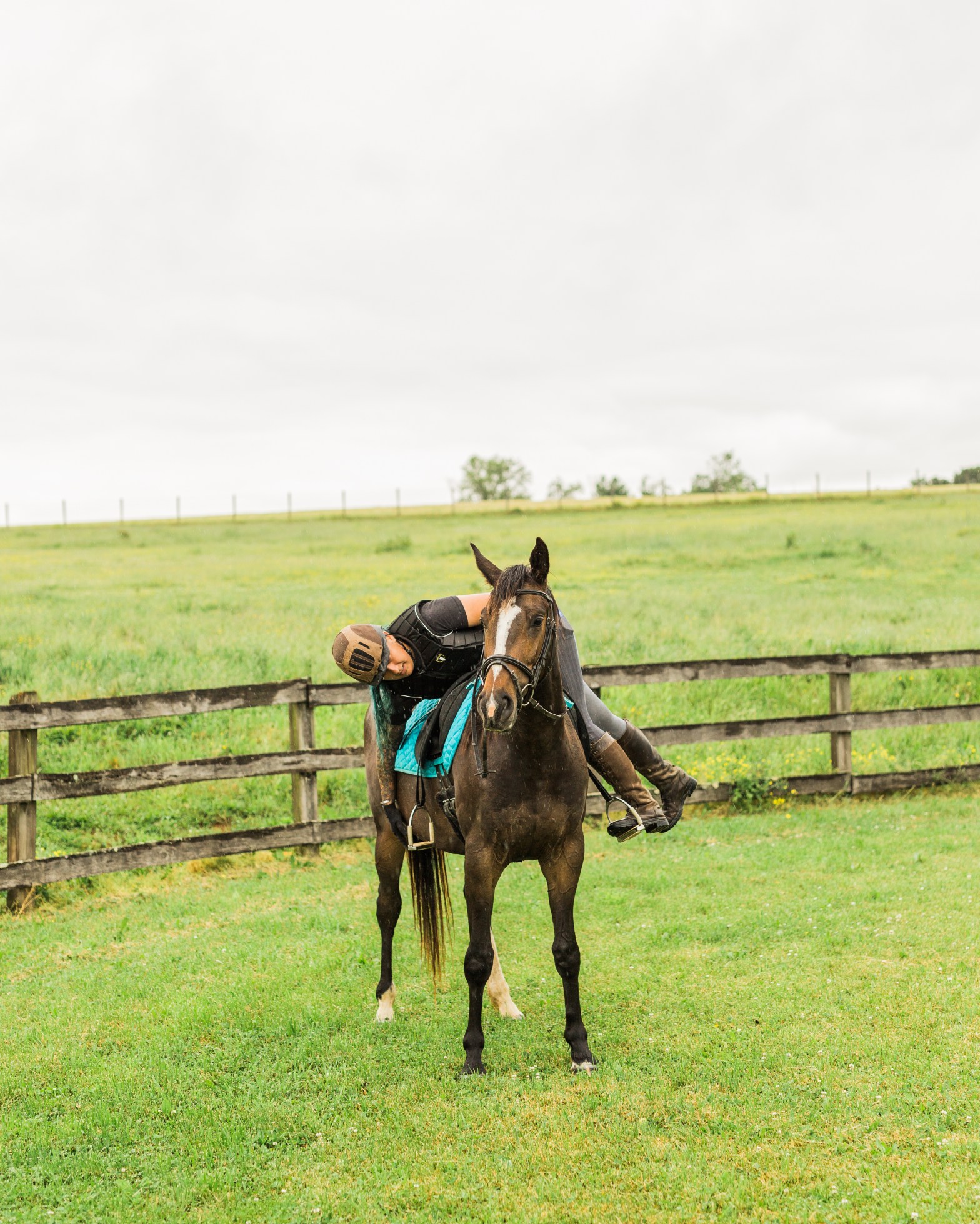
A bit about training, and why fear and force is not the way.

Given recent events on social media I feel compelled to address training methods and why fear and force is for some reason still a prevalent method of training. I want to open this by saying if you have yet to see the disturbing and disgusting video that surfaced of a top level eventing rider hitting a horse with a tree branch to get it to jump down a bank into water then you should count yourself lucky. Now I will not claim to be perfect, and I am sure that there have been moments in my riding career that I may have let my anger and frustration get the best of me but I can assure you that I would never, ever, in a million years think to grab a tree branch and start hitting a horse with it simply because it didn’t do as I asked. I have trained under people with the mindset of training through force and fear and I can tell you with 100% certainty this does not get you the results you’re looking for.

In my experience, it is better to move forward with a training method using positive reinforcement. It is always important to remember in training horses that every single horse is different and every single horse may require a different training style or method. We understand that people have different learning styles, so why is it so hard for some of us to understand that horses and animals are the same? Every single horse we train has something to teach us if we are willing to listen. I think the problem we’ve run into is that these trainers who use more forceful methods are of the mindset that it’s “my way or the highway” and don’t take the time to learn whatever it is that this horse may have to teach.

A lot of this may simply come down to a person’s upbringing and environment as they were learning to train horses. If you learned under a forceful type trainer you’re very likely to continue to use that methodology. Training through force and fear is so detrimental to the horses. It doesn’t instill confidence, and could cause other issues down the road if the horse ends up in the hands of a more timid rider. If you’re a trainer that finds forceful and fearful methods acceptable, it may be time to seek out attending clinics or taking lessons with someone who understands how to train without those methods. After all, riding is about a connection and partnership with the horse. It is not about dominating an animal. There should be a mutual respect between horse and rider. If there isn’t, you’ve put this animal in a situation where they feel whoever is the strongest has power. This will result in an animal becoming violent or dangerous in the hands of someone who does not exude the same dominating presence as you might. As an aside here, I do also want to add that we should not condemn a person because of one bad act. It is possible to learn and grow from it, and we should acknowledge when people do just that. I’m sure that every single horse trainer has a moment they’ve reacted in such a way that they’re now a bit ashamed of. We’re all learning and growing all the time.

This style of training through fear and force stems from one very frustrating and important factor worth discussing in this sport: the need for improvement and results. We should never, ever attempt to rush a horse’s training to meet our own deadlines. Setting a harsh deadline for your horse and demanding that they reach it is setting yourself up for failure. We shouldn’t be out here comparing ourselves and our journey with our horses to other people. Can you get a horse going under saddle in 30 days? Sure. Will that be possible for all horses? Absolutely not. If a client tells you they want their horse to be walk, trot, canter, and jumping 2’6″ by May 1st you can certainly try your best to accomplish that, but the last thing you want to do is resort to force and fear to do it. You could very well ruin the horse if you do. Instead, you have to be able to say that you will keep them updated on the training progress, and if there are any set backs you will let them know. How would you feel if your trainer said you had to be able to lift 500lbs by May 1st and all you’re doing now is carrying in your groceries from the car? Depending on your skill and strength that could be an incredibly unrealistic expectation. Why on earth would we do that to our horses?

Is it okay to set a goal with a deadline? Absolutely! Some horses could very well go from minimal handling to cantering around and jumping courses over the span of 2-4 months. You are not wrong to ask that the horse try to accomplish that goal. However, you absolutely cannot make that a hard deadline and forcefully demand results. Here’s an example: My horse Bill was jumping well at the beginning of 2021. Mid June 2021 he developed some confidence issues with jumping and we had to start from the ground up again, and were not jumping similar heights to May 2021 until late October 2021. This is OKAY. Did it disappoint me that we missed every single show and horse trial I had set out to attend? OF COURSE! Did I try to force him to do it just because I wanted to compete? No. Ribbons are NOT everything. The happier and more confident your horse is, the better you’ll place at competitions when you are both ready for them. There is no rush.

This is one thing I love about the US Event Horse Futurity process. I entered my young horse Cali (Tiny Dancer) into the futurity this year with the hope that we might qualify and make it to the championships. She’s moving along beautifully in her training but I can already tell she has some anxiety about the canter and it will absolutely need some work before we begin jumping under saddle. If she’s not ready for the qualifiers or championships, there is no penalty. The organizers of these events and processes understand that every horse matures differently and some may not mature enough to be able to qualify and compete, but they still promote the horses and their trainers anyway. Why? Because it is important to understand that the training process is not straight forward and simple for every horse. They are trying to bring light to the fact that there are always set backs in training and you absolutely have to take those in stride and just keep moving forward as best you can. If Cali and I don’t get to the championships I will not be angry or frustrated. I might be a bit disappointed as it is something I’m hoping for, but I will absolutely not try to force her to be ready.

The moral of this story? We as an equestrian community need to stop pushing hard deadlines and performance requirements on our horses. We need to take the time to train them at a pace that is suitable for the individual animal and not resort to force or fear just to see the results we want. There may be some cases where you buy a jumping prospect and later find out that the horse either has absolutely no talent or absolutely no drive to jump and that is OKAY. If you don’t want to do the same discipline the horse seems to prefer and/or excel at you should find someone who does and send the horse to a home where it will be happy. Is that hard to do if you’ve fallen in love with the horse already? OF COURSE! But we need to start putting our horse’s needs before our own and make the right choice for their mental health and quality of life. Your horse doesn’t care about the ribbons it’s won or the level it is competing at. Your horse just loves you and loves being a horse. The very least you could do is respect that and do what’s best for them.

Horses are animals that we connect with and build a bond and relationship with beyond just riding. They are our best friends. Why aren’t we acting like it?

Soft Hands!

A nice moment of relaxed connection between Crazy Wild Bill and I last fall (elbows slightly bent but extended so he can continue to reach down into the stretch)

Soft hands… You may hear this a lot but has anyone ever explained to you what it means? Or more importantly, has anyone ever mentioned this to you at all? I wanted to share a little bit about what I’ve noticed as I’ve been teaching a wider variety of students with varying experience levels.

We should strive to have soft hands at all times. I work on an “as soft as possible, as strong as necessary” mentality. We never want to be strong in our hands, and we should do everything we can to prevent that from happening. It is sometimes absolutely necessary to be stronger in our hands, especially when working with and training horses to understand what rein pressure, half halts, and other similar things mean, but once you have a well trained horse underneath you, the need for strong hands should eventually be very infrequent.

It is incredibly frustrating for me when I see students just pulling on the horse’s mouth, whether that’s to get the horse to turn, to get the horse to stop, or any reason really. I’ve had students start with me who were taught to pull this way. I often wonder if they’ve ever considered what that might feel like for the horse. We shouldn’t be steering with our hands, we should be steering with our body. If a student has been taught to steer with their hands it is so hard to break them of that habit, and truthfully it can be terrifying from a student’s perspective because it is so different than what they may be used to doing. In some cases, we’ve had to stop our progression to trot and canter and re-evaluate their ability to steer to get them on the right track with using their bodies instead of pulling. I have actually had a lesson horse get incredibly angry and upset with me because my students were pulling on his mouth. That showed me that I really needed to be more conscious of this problem and alter my teaching tactics to start getting to the bottom of this more quickly.

Recently, I started working in a new activity to my unmounted lessons where I have the student hold the bit in their fist while I do some of the things with the reins that they might tend to do to the horse. I have them focus on how it feels, and I also have them make note of how different bits feel as well. I’ve seen far too many people using bits that they don’t understand that are very harmful to the horse in the wrong hands, but that is an entirely different topic that I might cover in another post. I’ve found that this exercise is so helpful for some of my students who struggle the most with not pulling. I can actually see the light bulb go off in their head when they realize “oh my gosh I’m actually hurting the horse” and I see an instant change in their riding. Of course, it still takes a lot of practice, but I wish more trainers would take the time to show this to their students. We’d have many more happy horses if they did!

The other challenge I’ve run into, for those who do not pull, is the challenge of the straight and stiff arms. It seems to me that someone somewhere for these students made them believe that “soft” hands are hands that are stiff, rigid, and immobile. I imagine – or rather, I hope – that this was an unintentional consequence of having a student grab mane or hold onto a grab strap so they are not stabilizing themselves on the horse’s mouth. This is such a hard habit to break. If you knew the number of times I’ve shouted “BEND YOUR ELBOWS” at some of my students you’d be a bit shocked. Once they finally understand how to bend their elbows and have mobile/fluid hands the horse’s demeanor and their riding changes drastically. In a recent lesson, I actually walked up to my student, held her hand as she held the reins, and moved her hand in the way that it would be moving when she is riding at a walk so she could feel the sensation of a connected and soft hand. I then sent her back out to ride at a walk and the difference was so drastic the horse relaxed and connected with her almost instantly. It was incredible to see that change happen so quickly and it was one of my favorite moments in lessons so far this year.

We as trainers need to take the time to demonstrate and explain these things, regardless of the rider’s age, size, and experience level. I don’t care if they only want to wander around and trail ride, they must understand how their hands and their body affect the horse on a physical and mental level. If we don’t take the time to explain this, you end up with a rider with 10 years of experience who goes to a new trainer and has to re-learn the basics, which is frustrating for them and their new trainer in many ways. I’m hoping this inspires other trainers to add some of these unmounted activities, and helps inspire people to add in other training methods to help students understand these concepts so that they’re not angering their horses or becoming frustrated as they move on and move up in the sport. We should be teaching them to feel the horse and be connected with their horses rather than having the mentality that they will achieve their goals through rigid force.

The Winter Blues

Rigged Election and Owner/Trainer Kayla Robinson on one of the coldest days this month

I’m sure I’m not the only one who absolutely hates winter. In fact, the number of times I’ve seen “we’re in a half halt” these last few weeks has made me chuckle. It seems that’s the new way equestrians are saying they’re taking a short break. Winter is the hardest time of year for those of us who are not fortunate enough to have the ability to travel south. I often fantasize about one day having a program that would allow me to do that so I could show at the World Equestrian Center. Maybe one day that will happen, but I really can’t see myself staying down there for the entirety of winter.

We can’t let this winter blues get in the way of our riding and our goals though. We have to focus on the good moments, however few and far between they may be when we feel like we’ve been stuck in a polar vortex for a month. But let’s be honest, we didn’t just feel like we were in one… We genuinely were. Here’s the secret: If you just keep going, you’ll get so used to the cold it won’t bother you anymore. I know, that sounds stupid and probably insane, but it’s true. I found myself out in 20 degree weather, feels like 5 in a sweat shirt. No gloves needed. I rode 4 horses in a row that day and never felt cold. It’s incredible what our bodies can adjust to if we give them the chance.

My students are surely suffering from the winter blues as much as I am, so we’re spending time focusing on setting goals, looking forward to the longer days ahead and trying to decide what discipline they’d like to focus on. I’m an eventer myself, but that doesn’t mean all my students have to follow that path. I have some interested in equitation, some considering dressage, and many asking about jumping. Since we have these goals in mind we can begin to focus on things outside of just riding to prepare, and I’ve spent lots of time trying to keep the unmounted activities more fun and interesting. Have you ever had an instructor ask you to hold the bit in your hands while they held the reins and “rode” like you do? It’s a great exercise for self reflection and it can be pretty fun/funny when you trade places if your instructor is willing to pretend to be the horse to show you how the horse may react to your use of the rein.

As a kid I never experienced anything like this and as an adult and trainer now I’m beginning to see how these super simple moments can make a world of difference. I’ve seen so many lightbulb moments in the last few weeks as my riders unlock new skills, see what they’re really doing, and begin to understand how they affect the horses. Most riding programs who have indoor arenas don’t have to do these sorts of things because they can ride no matter the weather, but I am finding that this is SO IMPORTANT. I’m so glad I don’t have an indoor riding ring. I think back to how long it took me to learn certain things and realize how much faster I may have progressed if my instructor had taken the time to do this instead of just teaching me on a horse. And don’t get me wrong, I am in no way bashing the way I was taught, I am simply saying that my eyes have been opened to new and incredible methods that could’ve made a huge difference for me.

So the moral of this “winter blues” post is that we can’t let the cold weather get us down. We need to take this time for self reflection, motivation, and goal setting. Winter sucks and we know it. Let’s take the time inside and really plot out our course for the year. Ask yourself – Do I want to show this year? What level do I want to be by next Winter? Do I want to work toward having my own horse some day? Do I have any weaknesses in the saddle I could work on at home? Is there something I can learn watching other riding videos online? (this answer is yes. go watch videos!) Do I know what discipline I really enjoy? (if not, go watch more videos!) Set yourself up for success this year, whether you’re riding for fun or you want to go out and show.

Where should I start?

Given that I’ve entered the Young Event Horse Futurity with my home bred mare Tiny Dancer and I have to record frequent video logs (vlogs), I thought it may be time to start a real blog to document my journey into becoming a equine professional as well. I can’t say that I stumbled into this. It’s more that my passion was reignited and I saw an opportunity I never thought possible. You see, when I was younger, my best friend and I sat down together one day and drew up plans for an enormous boarding, training, and breeding barn that we wanted to run one day. It was huge, had two barn aisles and a massive arena for us to work in. It would’ve been incredible!

Unfortunately back then working with horses wasn’t something that my parents thought was a “career” and I was talked out of that by them and my mentor at the time for various reasons. I was told that you wouldn’t be anything if you didn’t go to school, so my career path through high school and my early 20s was always changing. I wanted to be a math teacher, or an architect. Then I decided to go into psychology, only to stumble into a career as a Database professional without even trying. None of these things were true passions of mine, they just seemed fun and interesting at the time. I was made to believe that I was a failure if I didn’t go to college, and found myself in mountains of debt before I really should’ve been. Long story short, my career as an IT professional lead me to realize that becoming a horse trainer IS achievable as a career, and if I work hard enough and pay down enough debt I CAN get there. So in 2021, I began the process of creating an online presence for my farm, with the initial hope of just covering my “husband horse” expenses, since he wasn’t riding his horse anyway.

What started out as just farm tours and a handful of lessons for anyone 18+ quickly sparked into a full blown lesson program and required me to expand my horizons and bring in more horses. I was stunned and confused, and at war with myself a bit. See I, like many people, struggle with negative self talk. When you are always telling yourself, “it will never work out”, or “no one will come to me for lessons because I don’t have anyone backing me or referring me to them”, or even, “I probably won’t be able to teach them much beyond what they might already know” you will struggle to move forward. Lucky for me, when I decided to expand my teaching offerings to ages 6+ I was swamped so quickly with clients I didn’t get the chance to really talk myself down. I also ended up with so many other local equine professionals backing me and referring people to me I was genuinely overwhelmed. 2021 brought me the most incredible realization, and most incredible opportunity in my life. I realized I CAN do this, and I AM doing this! What a thrill and a blessing to be able to finally accomplish that childhood dream of mine. And perhaps the best part was the fact that my family and my husband all came together to support it. In fact, my husband even started to challenge my negative self talk as we walked the course of the Maryland 5* as spectators. He said, “you’ll be here with Bill one day won’t you?” And of course, I responded with, “Are you crazy? I couldn’t do this, and neither could Bill.” To which he then said, “But Cali could.” And I shook my head. “Yeah, she probably could, but I don’t think that I can.” And he pointed out that I shouldn’t say that, because realistically if I tried, and had the right horse, I probably could at least get to the 2 or 3*.

Becoming a professional isn’t all unicorns and roses though. It is HARD. The vast majority of the general public probably aren’t going to see this as a real career, and you will run into people who will get frustrated with you for implementing policies around cancellations and reschedules just so you can continue to pay your bills. It’s even harder when these people know that you still have a full time job, because then this is perceived as a hobby or a side hustle and has even less respect. Just as an aside here – if you are reading this as my client, I do not direct this at you, I am simply explaining this so that others who are seeking entry into this profession are aware of what you’ll experience. I am in no way saying that any of my current clients feel this way, but I am also about to explain how this is more than a hobby, and how it consumes you as a person, so please read on if you do feel that this is just a “hobby”.

Horses consume you. They are your passion. They are your life. When you first dip your toe into the pond you’ll find that it’s incredible until you begin to rely on that money to cover your horse expenses. You’ll be ghosted by people, you’ll have no call no shows, and you’ll have people who will stick up their nose at having to cover half their lesson cost for a late notice cancel or reschedule because they have no idea the costs involved in keeping a horse happy, healthy, and ready for lessons. They don’t see the work you do, early mornings and late nights, to keep your farm looking nice and running well so you can teach them or their children. They will get upset if their child doesn’t progress as quickly as they’d like or they may even get upset if they can’t hand pick the horse they ride. You have to let this go, and you have to let the bad people go. They will weed themselves out. When you find a good group of clients they will share your passion. They will come out on the coldest nights and the hottest days. They will pay those cancellation fees or they will reschedule because they know how important keeping up with lessons is, and they also know the costs involved. I once had a parent say “I’m clearly not paying you enough for lessons” when I was explaining the costs of purchasing a horse these days. But truthfully, my goal as a trainer is to make riding affordable as much as I can. This also means I have to be strict with my policies and my boundaries and make sure people pay.

So I’ll finish this blog with two messages. One is a bit of advice for people seeking entry into this field – because YES, this is a CAREER, and the other is to people seeking to get riding lessons and training for themselves or their children.

To my readers who want to be a riding instructor or trainer: Don’t give up. Keep those boundaries strong. Create a solid plan and stick to it. Make sure you communicate effectively. Don’t reply to people when you’re angry. Don’t get so angry about a no call no show. Like I said, the bad clients will weed themselves out and it is OKAY to let them go. Be open and transparent with your clients. If you have a goal, if you’re struggling, if you need something, tell them. Believe it or not if you have a good client base they will move mountains for you, and I’m lucky enough to have experienced that already. So basically – give good and you’ll get good. And most importantly, make sure to look out for yourself. Plan days off. Make sure your expenses are covered and do not hesitate in the slightest to stick up for yourself. YOU DESERVE IT! Don’t give in to a request just because you feel like if you don’t, you’ll lose that client. Understanding people and good clients will respect your boundaries. I promise!

To my readers who are looking to get their children into riding: If they truly love the sport, prepare yourself. Make sure you’re ready for this commitment. Understand that this is their trainer’s income and career. Be courteous, and be kind. Horses are insanely expensive. Do not throw a fit when you have to pay for your lesson because you cancelled just an hour before hand. Think of it this way – you may see your cancellation as “just one lesson”, but what if everyone that was on the schedule that day thought the same thing? After a certain number of cancellations your child’s trainer can no longer pay their bills. If they can’t pay their bills, they have to sell their horses and that means no lessons for anyone! So once again, be kind, and understand this isn’t just a hobby for us. This is our life, and we willingly give it to you. We spend so much time researching, prepping lesson plans, trying to find the best way to teach you or your child. It’s hard work! Most of us take lessons with more advanced trainers to continue our own education as well so we can bring that back to our students. And on top of that we have to continue to care for all our horses or they won’t work for us. The average bag of feed is $20-40. The average bale of hay is $5-15 (small bales) or $70-200 (large bales). Most horses would go through a bag of feed per week or more, and most horses would go through half a bale of hay if not an entire bale of hay a day (small bales anyway). Not to mention that the horses need trims and/or shoes every 6 weeks which costs on average $50-150 per horse, and they need regular vet care which will run approximately $300-400 per year per horse assuming there are no emergencies. Bedding adds up even faster, and all that equipment (bridles, saddles, girths, saddle pads, horse blankets, water buckets, feed buckets, storage for feed, storage for tack, office supplies, legal fees for waivers, insurance, etc). This is not a cheap profession! We just ask for respect and courtesy, and in return we’ll move mountains to make sure that you or your child achieve all your riding goals.

The moral of this whole post is that I am immensely thankful for the client base I’ve been able to build. I am incredibly excited to train the next generation of equine professionals, or even just amateurs who enjoy riding their horses. 2022 is hopefully going to be a continued year of career growth, and lead me closer to a full time career as a horse trainer.